

By Grace Phippard, Baby Squids Swimming Teacher based in Exeter, Devon.
Every parent wants to keep their child safe, and with child drownings in England
tragically doubling since 2019, the importance of early water safety has never been clearer. As risks rise, more research is being done into baby swimming lessons,
revealing powerful benefits that go far beyond splashing and floating. From learning essential life-saving skills to enhancing babies’ physical, psychological, and cognitive development, there’s a growing body of evidence supporting early swim education.
In this article, we’ll explore the latest findings and show why getting your baby into the pool might just be one of the best decisions you can make.
Water Safety and Life-Saving Skills
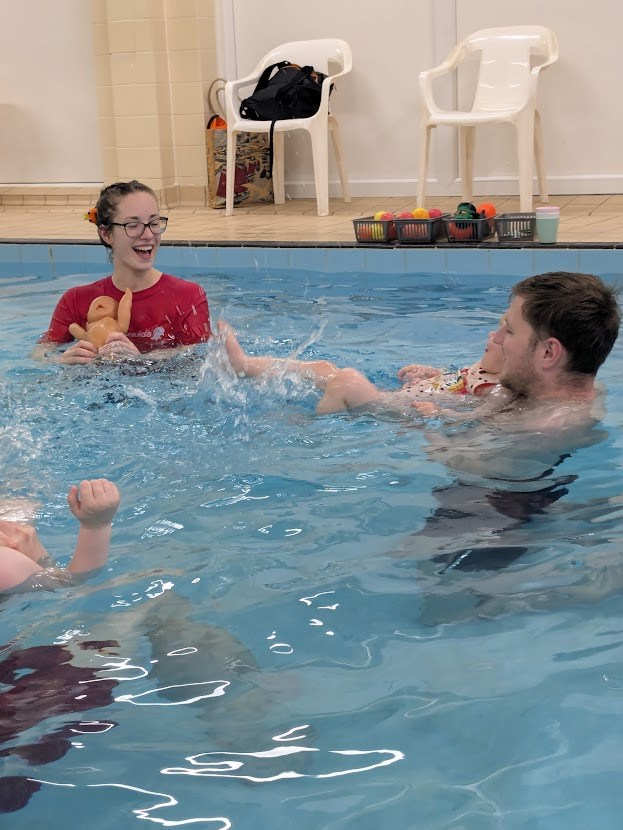
Did you know that babies are born with a natural “swimming” instinct? From around four months old, when water flows down their torso, babies automatically begin to kick, splash their arms, and wriggle their bodies in what’s known as the amphibian reflex. This reflex happens without the brain’s input- it’s automatic. In baby swim lessons, instructors use this natural movement as a foundation. Caregivers are taught to say cue words like “kick, kick, kick!” while the reflex is being triggered.
Cue words are simple phrases used to prompt specific behaviours, in this case,
swimming movements. Over time, and with plenty of praise as positive
reinforcement, babies begin to connect the cue with their actions. Eventually, they
form new neural connections in the brain, transforming the reflex into a learned skill. Now, when a parent says “kick, kick, kick!”, The baby remembers what to do. This early learning not only helps improve your baby’s swimming ability for life but also strengthens their brain by creating new connections, supporting their cognitive development from the very beginning.
Another lesser-known reflex babies are born with is the gag reflex, which prevents
them from inhaling water. When water enters a baby’s mouth, the reflex kicks in,
automatically closing the trachea and protecting the lungs. But here’s the catch: it fades around the age of one. That means older babies who haven’t learned to associate the feeling of going underwater with breath-holding are at higher risk of inhaling water and drowning. In swim lessons, babies learn to associate being submerged with holding their breath, thanks to repetition and cue phrases like “Ready… GO!” Parents and instructors use these cues before submerging the baby so the reflex can be intentionally triggered. With practice, the baby learns to hold their breath even after the natural reflex fades, replacing instinct with a skill that could one day save their life. “Ready…GO!
Motor Development
Water gives babies the freedom to move in ways they simply can’t on land.
Buoyancy reduces the effects of gravity, allowing babies to explore their movements earlier, more freely, and with less effort. This leads to increased muscle use, coordination, and the strengthening of connections between the brain and body.
Research has consistently found that babies who attend regular swim lessons
develop better reflexes and grasping abilities, along with stronger fine and gross
motor skills like hand-eye coordination and cross-lateral movement. These
improvements can lead to babies reaching physical milestones, like sitting, crawling, and walking, sooner than expected.
Take Iceland, for example, where over a third of babies attend swim classes. A study by Reykjavik University revealed that infants who swam for just two hours a week were able to stand assisted in the water from four months old, five months earlier than typically expected. That’s a huge head start in building strength, balance, and overall sensorimotor development. Regular swimming also boosts stamina, cardiovascular fitness, joint mobility, and lung capacity, giving babies an all-around physical edge.
Neural Development
Swimming isn’t just good for the body, it’s a serious workout for the brain, too. That same study from Reykjavik University found that regular swim lessons helped improve babies’ concentration and attention spans. As babies learn new movements and associate them Neural Development Neural Development with verbal cues, their brains are forming stronger, faster connections. Other research has found improvements in inhibition speed (how quickly babies can stop impulsive reactions) and task switching skills, important traits for future learning and emotional regulation.
These early cognitive abilities help babies adapt to new environments, focus for
longer periods, and better understand the world around them. In short, splashing
around might look like fun and games, but there’s real brain-building going on
beneath the surface.
Health Benefits: Sleep and Appetite
If you’ve ever taken your baby swimming and noticed they conk out afterward, you’re not imagining it. Swimming offers a powerful combination of physical exertion and sensory stimulation, both of which help tire babies out in the best possible way. Many parents notice improvements in their baby’s sleep-wake cycle, with longer naps and better night-time sleep.
And it’s not just sleep that gets a boost, appetite does too. All that activity increases calorie expenditure and hunger, which supports healthy growth and physical development. So, if you’ve got a fussy sleeper or a picky eater, baby swimming might just be the unexpected fix you’ve been looking for.
Bonding and Emotional Connection
Swimming lessons are also a beautiful opportunity to bond with your baby. Skin-to-skin contact in the water, the shared experience of trying new things, and the
moments of eye contact and laughter all strengthen your connection. Skin-to-skin contact helps regulate babies’ autonomic nervous system: the system that controls heart rate, digestion, and stress. It also lowers cortisol (the stress
hormone) and raises oxytocin (the love hormone), creating a sense of calm and
happiness for both parent and baby.
One study from Vienna University even found that swimming lessons significantly
improved the quality of attachment between mothers suffering from postnatal
depression and their babies. And we know that secure attachment is vital for
children’s long-term emotional wellbeing, it lays the foundation for healthy
relationships, higher self-esteem, and resilience later in life.
Confidence and Personality
As babies explore the water, try new activities, and receive encouragement for their efforts, they begin developing a sense of self confidence. They learn that they can overcome challenges, respond to cues, and achieve things they didn’t know they could do. This self-belief grows with each class, laying the foundation for a resilient personality. Not only does this water confidence help when it’s time for formal swimming lessons later in childhood, but studies show that children with higher self-esteem are more likely to carry that confidence into adolescence and adulthood. That means they’re less likely to depression, experience or struggles as they grow. Swimming lessons offer a safe space for babies to try, fail, succeed, and feel good doing it.
Conclusion: Time to Dive In!
From improved motor skills and stronger brain development to better sleep, closer bonding, and essential life-saving skills, baby swimming lessons offer a full package of benefits that go far beyond the pool. If you’ve been on the fence, consider this your sign. Look for a baby swimming class near you, grab a towel, and dive in. It might just be the best gift you give your baby… and yourself.
References:
Borioni, F., Marzoli, D., Cavallo, A., & Di Corrado, D. (2022). Effects of baby
swimming on motor and cognitive development: A pilot trial. Perceptual and Motor Skills, 129(4), 1045–1063. https://doi.org/10.1177/00315125221090203
Driscoll, M. (2024). The effects of baby swimming classes on postnatal depression
and mother-infant attachment (Publication No. 31840742) [Doctoral dissertation,
Webster University]. ProQuest Dissertations & Theses. https://doi.org/xxxx
Fischer, D. B., & Truog, R. D. (2015). What is a reflex? A guide for understanding
disorders of consciousness. Neurology, 85(6), 543–548.
https://doi.org/10.1212/WNL.0000000000001748
Henriksen, I. O., Ranøyen, I., Indredavik, M. S., & Stenseng, F. (2017). The role of
self-esteem in the development of psychiatric problems: A three-year prospective
study in a clinical sample of adolescents. Child and Adolescent Psychiatry and
Mental Health, 11, Article 68. https://doi.org/10.1186/s13034-017-0207-y
Leo, I., Leone, S., Dicataldo, R., Vivenzio, C., Cavallin, N., Taglioni, C., & Roch, M.
(2022). A non-randomized pilot study on the benefits of baby swimming on motor development. International Journal of Environmental Research and Public Health,19(15), 9262. https://doi.org/10.3390/ijerph19159262
National Child Mortality Database. (2023). Child drowning deaths in England: 1 April 2022 to 31 March 2023. https://www.ncmd.info/wp-content/uploads/2024/07/Drowning-report-17-July.pdf
Royal Life Saving Society UK. (n.d.). The importance of baby and toddler swimming. https://www.rlss.org.uk/blog/the-importance-of baby-and-toddler-swimming
Santos, C., Burnay, C., Button, C., & Cordovil, R. (2023). Effects of exposure to
formal aquatic activities on babies younger than 36 months: A systematic review.
International Journal of Environmental Research and Public Health, 20(8), 5610.
https://doi.org/10.3390/ijerph20085610
Sigmundsson, H. (2021). Specificity of learning, skill development and baby
swimming in Iceland. Journal of Physical Education and Sport, 21(Supplement 1),
549–552. https://doi.org/10.7752/jpes.2021.s1061